SITAR EXPLORER
The Sitar, strange, exotic, beautiful; ‘other’. These associations and many, more mundane descriptions appear in the western mind for reasons that usually lack an understanding of the fundamental difference between Indian classical music and how music is created in the west. The simplest way to make the distinction is to understand that with Indian music the focus is primarily on melody and how a single melody can be developed and expressed in a myriad of ways with an emphasis on improvisation. Western classical music is usually composed polyphonically with and emphasis on harmony; the many notes of the orchestra playing in ‘harmony’ together.
Another important difference between the two musical approaches is that western compositions are usually written down, “notated” and a performance of a “piece of music” is supposed to conform to the the document by reading and playing as intended by the composer. It is safe to say that western music is ‘fixed’ in this way with interpretation and emphasis more in the baton of the conductor than the musician. Indian musicians on the other hand memorize their compositions or “Raga’s” which are thematic phrases that are repeated in different ways. The musician is the interpretive power to embellish, deepen and expand the melody through improvisation.
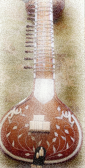
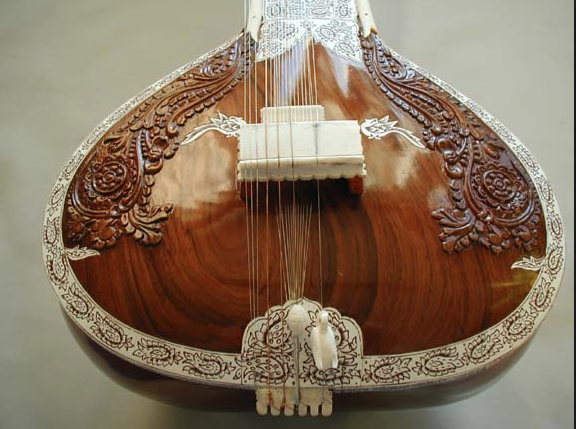
Aside from the resistance some people have to it’s unusual shape and design coupled with it’s twangy and seemingly monotonous sound, investigating a little more deeply reveals that the sitar is beautiful both sonically and in design. Sitars are ingeniously crafted with humble means but is in fact one of the most spiritual instruments ever created.
The Sitar is usually considered difficult to play and indeed difficult to tune with up to twenty one strings. The tuning pegs themselves are not mechanical but are made of wood and fit into rounded slots that require friction to hold them in place. This means that the whole instrument is suspended in tune under great tension with nothing more holding the strings than a snug fit of the tuning pegs and a little chalk.
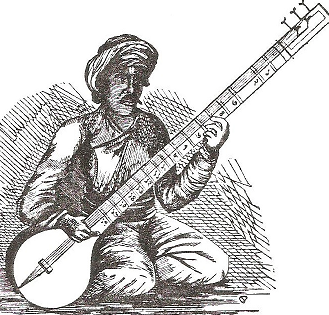
The origins of the Sitar are shrouded in some mystery with fables dating as far back as the 14 century but there are no historical records or artistic depictions from that time. The Persian “Setar” (top left) is often noted as the source of the name “Sitar” Both are considered
Lutes, so it is possibly a beginning but the similarities between instruments seem to be essentially phonetic; the sitar itself being so different in design and sound that it is probably better just to say that both are simply ‘chordophones’ or instruments that make sound by way of a vibrating string or strings stretched between two points. If we are considering “origins” we must go back much further than the 1300’s, in fact, for the source we must go back many thousands of years…

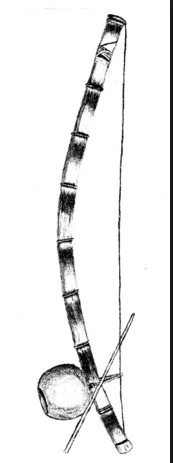
…Consider the bow, as in bow and arrow. Our primitive ancestors made a technological leap by tying a cord of animal hide to a long dry sapling and threading an arrow. This revolutionized hunting and also warfare but the more sensitive soul soon realized that when not hunting or fighting the bow could be used as a rhythmically enchanting musical instrument. The instrument still exists today as the ‘Berimbau’ from Brazil (left) but originated in Africa. Notice the addition of the gourd as a resonating chamber. The development of stringed instruments from these humble beginnings is nothing short of astounding in itself but if all other technologies, good and bad are considered together, then the inner template of the human form is beyond sublime. This means that inside of each human being exits a profound storehouse of creative
potential. The trick of course is how to tap into that potential, but it might be more important
for any individual to understand ‘why’ one should attempt to harness such archetypal forms before
parading the discoveries before the world for the simple reason that the power can become deluded
and wasted in the muddy waters of vanity and greed.

Screen Shot 2012-06-21 at 2.33.02 PM
Screen Shot 2012-06-21 at 2.33.14 PM
jRjMural1
jRj-logo_03